Dear Family and Friends,
Having made it across country in five and a half days, we hit the ground running. First was rendezvousing with our boss to pick up our stored uniforms, keys, and get the update on radio channels and protocols. One moment it feels like we never left, and the next moment we realize a few things have become a bit foggy in disuse — like the place names for locations in the park not on the visitor maps. Where the heck is “Poison Pond?!”
In our Gros Ventre campsite in the south end of the park (until the water is turned on up north), we routinely found shaggy moose, almost white from their thick winter coats shedding, in and around camp. When opening the Airstream door, we were sure to sing out “Good Morning Moose!” But before we can get to work, we make a quick trip to Airstream of Wyoming to get our propane tank pigtails replaced. Essential for cooking and heating! They fit us in and had us turned around in a couple of hours. Awesome dealership!


Our first day back on patrol, we had a 3+ hour moving animal jam with a grizzly bear spotted in some aspen on the left side of the road. She (we think) crossed to the east side and munched on newly sprouted grasses. Then it decided to walk parallel to the road, heading north, towards a busy intersection. The photographers ran for their cars to leap frog the line of parked vehicles to get close for another chance to photograph the bear. It decided to cross again, and eventually at least one more time to the far side of the intersection where it could hide in the willows. Classic!
That afternoon we were called to a bear off the main road through the park. It was a stunning bear to see through binoculars. Clearly healthy, this large grizzly’s coat shone like polished copper across its shoulders in the peek-a-boo early May sun. It was hard to see as it grazed more than two hundred yards out, so we had very little in the way of people or cars to manage and could indulge in the rare occurrence of watching the bear at a bear jam. We suspect it was a young bear from its behavior. You could see it raise its head and sniff the air frequently. It was sharing Elk Ranch Flats with, well, elk. There was a small herd of elk, from the National Elk Refuge in Jackson, moving north at a stomach’s pace, grazing at the edge of the trees along the river running below the snow covered Tetons.
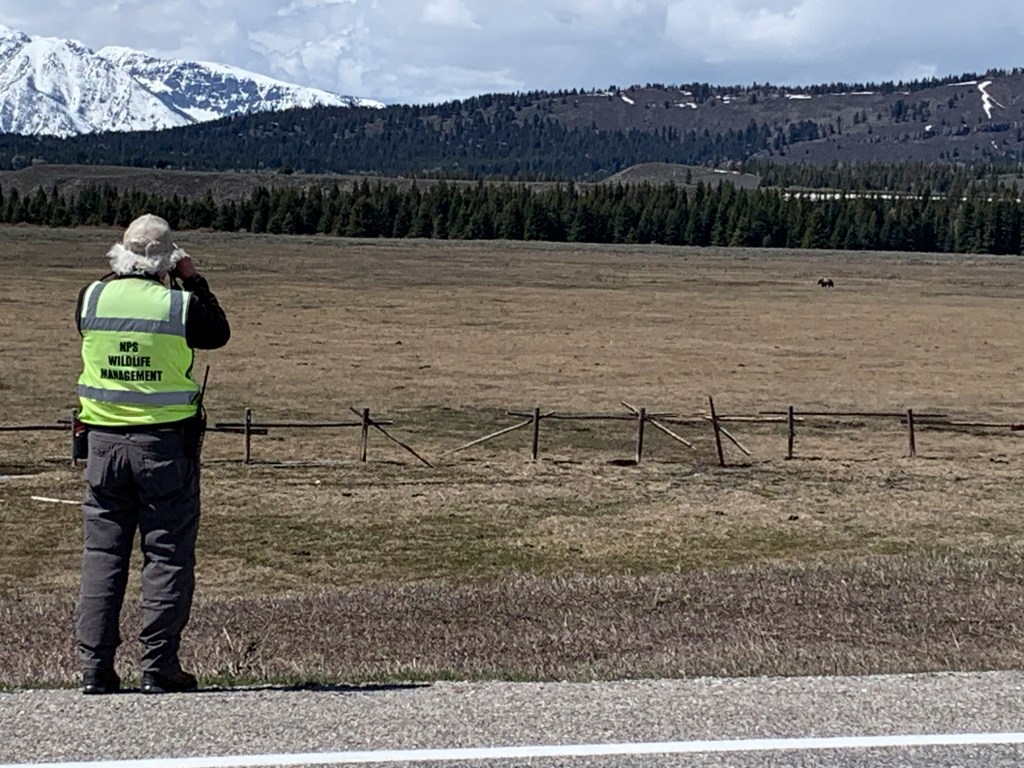
This bear clearly decided that elk should be on its menu today. And set about finding itself something to sink its claws into with a very straight forward approach, running straight into the heart of the loosely organized herd.
It was like watching a slapstick show with the villain charging a closed door, and the supposedly trapped occupants of the house opening the door and letting the bad guy charge right on through and out the back door. If there had been a thought bubble over the elk’s head, it might have read, “Is that all you got?”

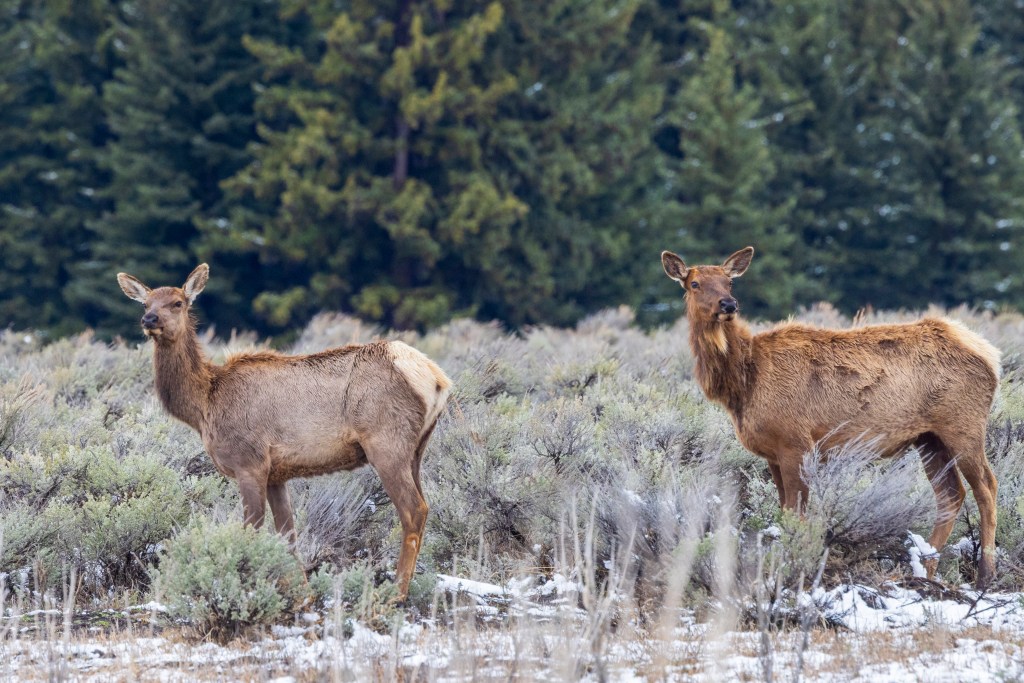
Then something shifted in the dynamics, with the herd taking the bear more seriously and briskly forming up and heading towards the river and out of our sight. The grizzly trailing. But then, we could see the herd reemerge a little down stream to our left, and begin grazing again. The grizzly popped up to our right (still several hundred yards out so we continued to watch the drama through binoculars) and the herd went into a defensive posture. They made a large wall, shoulder to shoulder and butt to butt, facing out. Young Griz, circled without figuring out how to get one alone and convince it to join it for dinner. Fascinating!
The reason we think it is a young bear is that adult elk can out run an adult grizzly, who by the way, can run about 43 miles an hour. But grizzlies can catch elk calves, until the calf is four weeks old, and then it is as fast as Momma. So the grizzly clearly had a taste for elk, just missed the class on having to wait for the young ones — which will start in mid May.
But to continue the roadside saga, the bear circled the herd, 360 degrees, and then laid down in the sage, disappearing from view entirely. Eventually the herd forgot about it, and started their slow walking-foraging and spread out from their tight, defensive unit. When it couldn’t take the waiting anymore, the bear popped up and tried another catch. There were no obviously ill or weakened elk in the group that might give the advantage to the bear, but it was persistent. It was fun see a bear work through different hunting strategies in one morning. Eventually, our shift was over, and we turned over duties to the afternoon shift, who promised to tell us if the bear had a victory on their watch. Nope.
We did have a lovely email from a good friend and ranger at shift’s end. “I’m quite certain I heard #callsign# Titley on the radio today! Welcome Back!” We can hardly wait to plan a campfire and see everyone again!
We got to set up camp in our season spot up in Colter Bay. A generous site, as it was once home to a mobile trailer. The down side is that the sewer and water are 50 feet away requiring every extension we had. And with the Very Generous help of our supervisor, we engineered a more or less straight run from holding tanks to receptacle using rocks, a scrap of lumber, and a very stretched stinky slinky. That is definitely going above and beyond to help your employees! Our hearty thanks to JS!


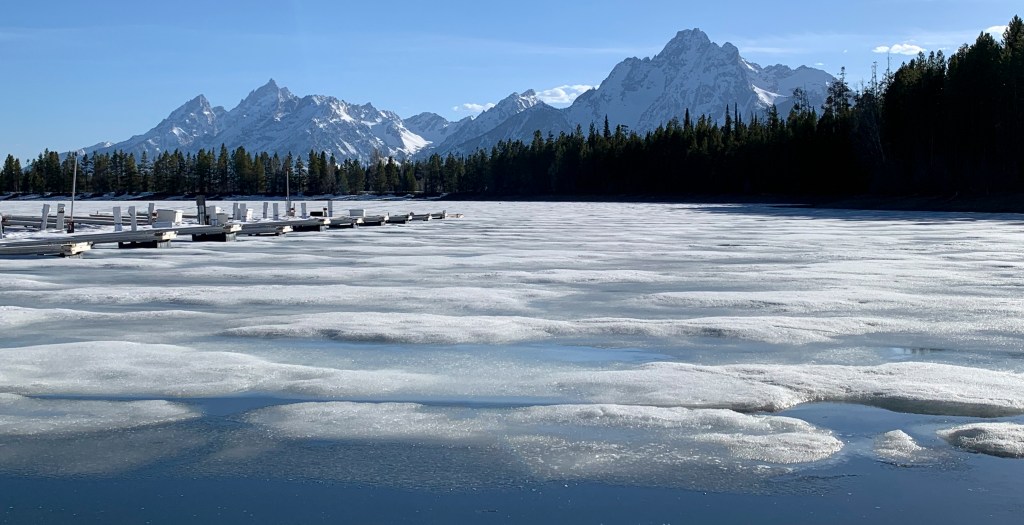
My favorite thing — smelling the pine and cedar every time I open the door! My site is next to, and across the street from, other Brigaders, so I feel very confident that should I need help with anything, it is close at hand. I am so lucky!
Our next few days are a blur of domestic chores, such as laundry, and the grocery run into town, 35 miles away. Dave instructed me in operating some of the systems on the RV he was usually in charge of (just like I had to teach him how my hydroponic tomato garden at home works). Next thing you know, it is time to start the next shift!
On May 5th, we had a very dynamic jam with 8 year old grizzly 1063 and her three yearling cubs. This is a bear we worked with a lot in 2023 and we delighted to hear the first time Mom had emerged from her den with triplets in 2024. More often, new mothers bear (haha, pun intended) a single cub. So starting off with three really says something about her body condition when she went into the den!
That afternoon, we had two inches of snow, falling like fat, wet, flapjacks and hitting with a sloppy smacking sound. Several more inches fell in the nearby passes.

The next morning began with GB+3, also known as 1063 and her cubs, still near the road at the entrance to Leeks Marina where we left her yesterday. This spot is challenging to manage because the visitors are faced with what I call ‘keyhole photography.’ The bears might be grazing in an open spot, but to see them, you had to get the perfect angle through a narrow gap in the trees — like a keyhole. That puts a lot of pressure on the available real estate to accommodate the visitors, in addition to the usual issues involving parking, road walking, standing in the road, and of course, getting too close to the bears. I regret not taking a picture of the clusters of photographers, some sitting on the roadside on coats, some kneeling, some perched on snowbanks, and others on tip-toe trying to aim their smartphone over the shoulder of the person with the 600mm lens. A bit like stuffed circus clown cars.
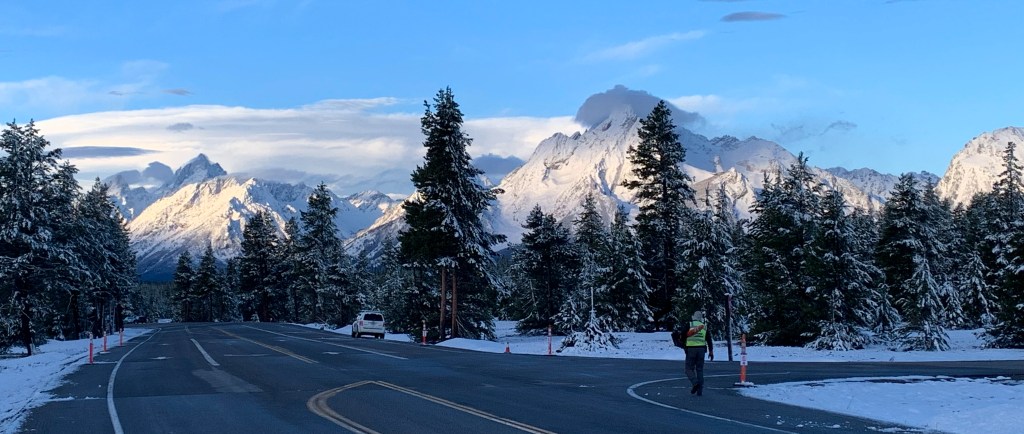
I only caught glimpses myself, but I have some lovely memories of the cubs rolling in the fresh snow, feeling the bite of the wind on my cheeks, and smelling the glorious mountain air.
Wednesday morning greets us with 29 degree mountain air. The heat pump would not have had enough strength to overcome these temperatures, so I am very grateful for the Airstream dealer and new propane connections! With mixed emotions however, it is time for Dave to fly back to PA and continue his work on guiding RV Weather. Mixed? I am sad to see him go and not continue our shared adventures together in the park. But, we’ve done this before, many times. It is like a reverse deployment in our previous Navy life — this time Dave mans the home front and I have work of another kind. And so a part of me is interested to see what I will experience in the park on my own. At least for this deployment, we now have upgraded from USPS “snail mail” to text and zoom calls. <3
After seeing Dave off at the airport, I reviewed the list of tasks I planned for the day in my bullet journal, and promptly ignored them. I had a camera, fresh batteries and twenty miles of National Park attractions between me and camp. The list could wait.

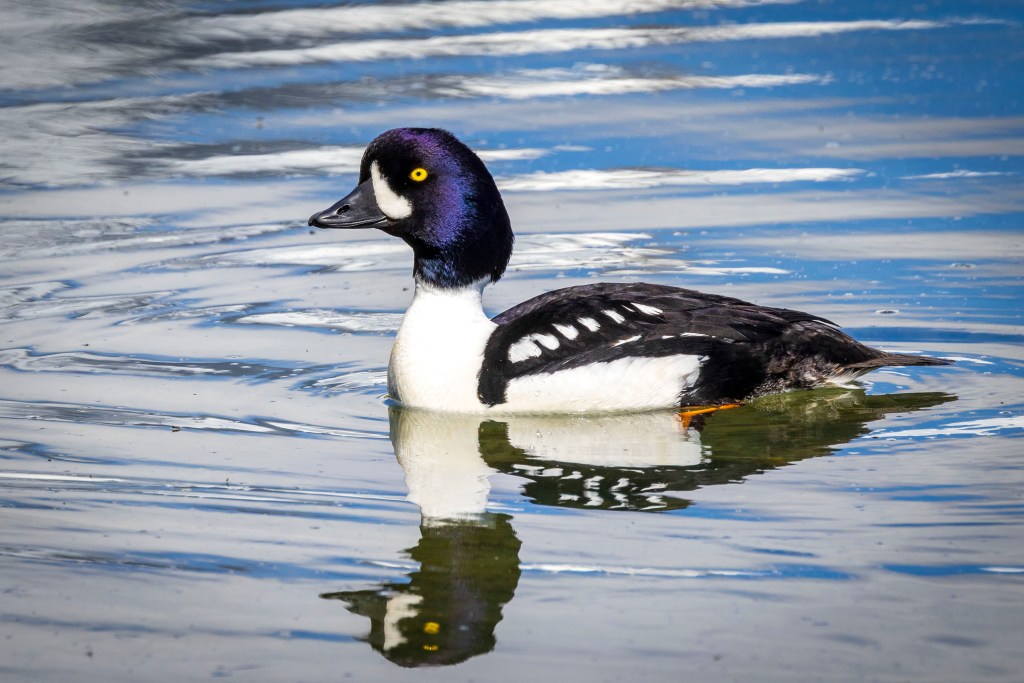
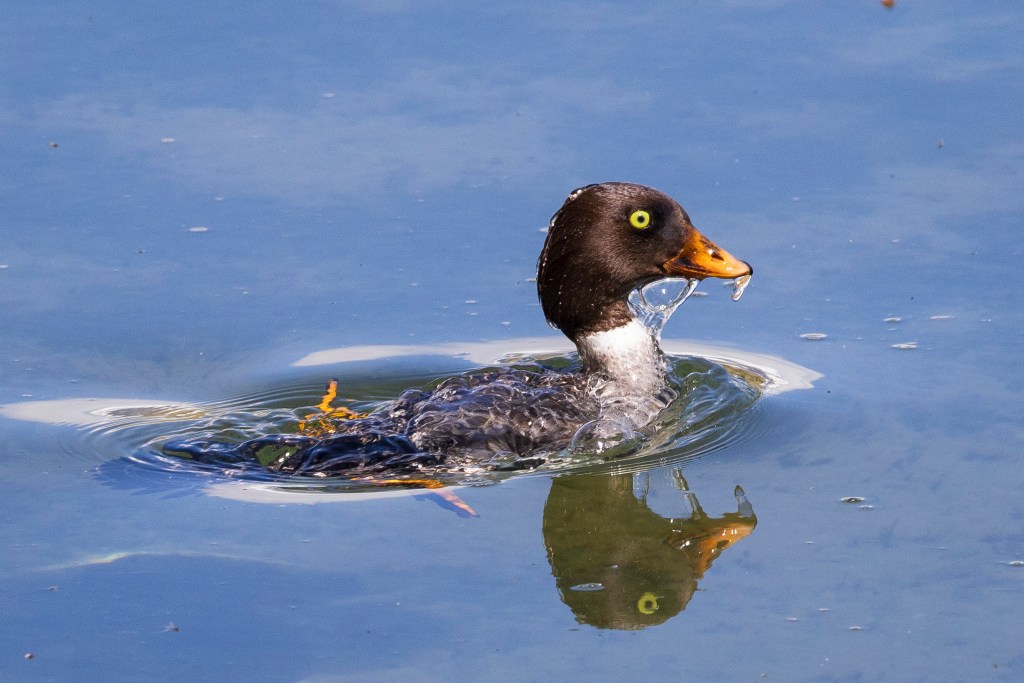
One of my favorite stops early in the year is to Schwabacher Landing. One section is the location for some iconic images of the Tetons framed amongst trees and reflected in a still beaver pond. A less visited section down river is a place I like to go because I often get into interesting encounters with ducks here. This time, I met a mating pair of Barrow’s Goldeneye. I’ve seen Mom with her ducklings before, but never Dad with his striking coloration. The female was constantly diving to feed, while the male circled close by, keeping an eye on things.

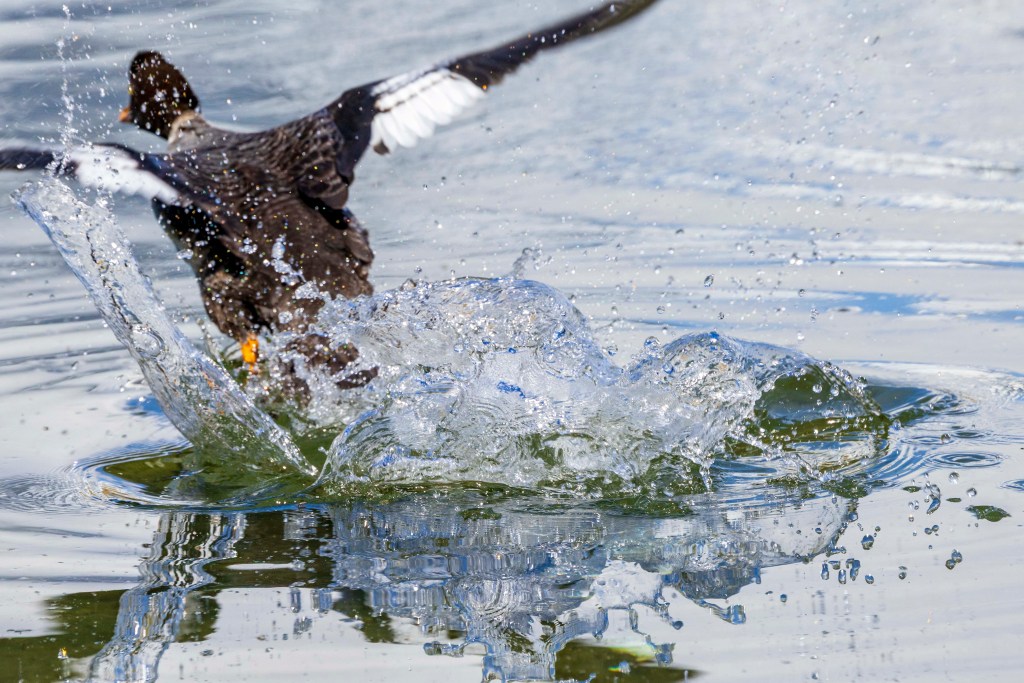
Eventually the pair flew off and I went to explore the other section of the river. You’ll love this. At upper Schwabacher and I opened the propped open outhouse door (it is supposed to be closed at all times). Scaring all of us: two dark squirmy shapes skittered in circles on the floor and hid behind the unsecured trash barrel. So I stepped back, opened the door all the way, and told the two little faces sticking out I wasn’t going to pee with them in there so they needed to get out. And they did! One stopped next to my boot, looked up at me, and took off!

I was hoping to catch Yellow Rumped Warblers or Ruby-crowned Kinglets in my viewfinder. Merlin (eBird) listened to the bird song and could tell me they were there, but I just never spotted them. A Canada Goose was nesting in the spot I usually saw Red-wing Blackbirds nesting. Large parts of the pond that once reflected the mountains are filling in with tall, waving marsh grasses. Such is the nature of nature. Always change.

Before heading back to the RV, I decide to see what the bear situation is like, in case I might get some photos of my favorite bear and her cubs. I get a couple of photos but it is too much like combat.
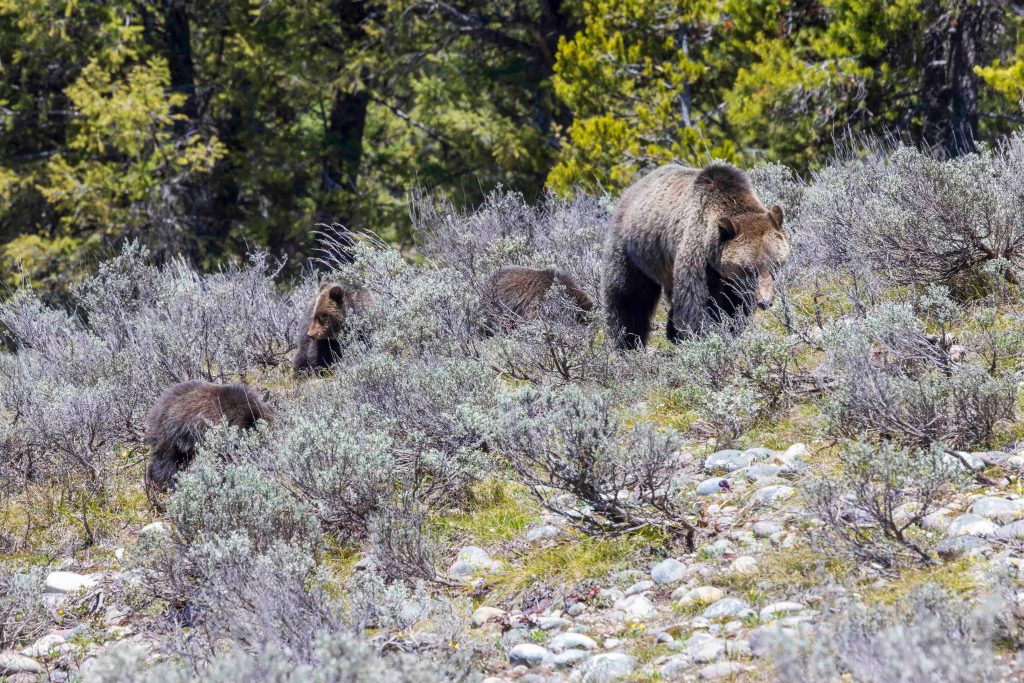
While I am off duty, 1063 and her cubs continue to create challenges for visitors and wildlife manager alike. She has moved from the tree and meadow area of Leeks into the developed area known as Colter Bay — where there is not only housing for rangers, volunteers, and concessionaires, but also two campgrounds, a Visitor Center, general store, gas station, laundry, restaurant, cabins to rent, horse corrals, and a marina.
Thank goodness for two things: 1) Colter Bay visitor services are weeks away from opening, and 2) the south entrance of Yellowstone is still closed due to snow — and so the number of visitors to be managed as we attempt to escort the bears through the landscape and on to greener pastures as it were, is thankfully less than it will be in just a few weeks.
Meanwhile, Dave has shifted into ‘real life’ quickly — he does a fine job as the commencement speaker for the College of Earth and Mineral Sciences at Penn State. He is also back in technical meetings with our software engineers scoping out new and improved capabilities to offer our customers.
For me, it is time to figure out if I can do this job as a solo unit. A battle of self confidence you could say. I am grateful beyond measure that when I voice my concerns to my boss(es), they always smile, and answer “We will work it out.” And they do. Not all of my butterflies are gone, but many are.
Since I live in the part of the park the grizzlies like to frequent, I was very worried that I would encounter the bears at 0600 (certainly, that is when the photographers arrive) and have to manage a jam by myself until support could arrive. The closer the bear is to the road, the crazier the jam gets. Our ranks in the Wildlife Brigade are still filling as other volunteers make their way across the country to the park. Thankfully, 1063 is a sleep-in kind of girl, unwilling to be seen until at least 0800, and my boss reached out to other resources to make sure I would have help if needed. I was not as alone as I felt.
This week, 1063 keeps us on the run. She seems to have left the developed area of cabins and corrals for the area closed to the public known as Dump Road. This is the western edge of some of the best grizzly habitat in the park, and it is closed while the food source remains of nutritional value and attraction to the bears. What this means for us, is that she can feed in peace beyond view if she wishes, or if she chooses the area in front of the tree line, visitors can line up along the straight and flat roadway to get their photographs of a grizzly and her cubs. A much more organized chaos.
The rangers and brigade breathe a sigh of relief — we got her past the hard stuff and now she has what has been set aside for the benefit of the grizzlies in the park. Let the easy viewing opportunities commence!

But that is not to be. The next day we find Miss Sleepy in ranger housing, in the woods next to a home with three young kids and a community playground. (and essentially around the corner from our RV as the crow flies!) We try and convince her with noise that developed areas like human homes are not a welcoming place.
Within a half hour, she has circled around housing and the maintenance yard to end up back on the main road, in extremely difficult terrain. The road has a steep hillside on one side, and an abrupt drop off on the other. The road is serpentine so sight lines are short. We find people just about on top of her and the cubs.
We do our best to create an open space, a bracket, that she can use to cross. At the same time we are trying to manage parking, and find a safe place, the minimum of 100 yards away for visitor viewing. 1063 goes up and down the slope, back and forth across the ridge, in view and out of sight. More keyhole photography. We are constantly shifting road cones to maintain safety balanced with access. We stop traffic numerous times to let her cross if that is what she wants,, but instead she lingers and eats roadside.
We need to haze her away from the road so she isn’t so comfortable there, and especially so she doesn’t teach her cubs to be at ease on roadways. It had already been decided months ago at higher levels in the park that this season bear management would be more proactive about keeping bears from remaining too close to roadways. Last year grizzly 399 was hit and killed. 610 was hit but survived. Late last week one of 399’s cubs was killed in a hit and run. And this morning a black bear was hit and killed by a car. In 2023 seven bears were hit and killed in the park. The annual average is 3-4 bears killed by vehicle. We are at 2 in one week.
So it isn’t undertaken lightly. There is a spectrum of techniques and tools that are used, following extensive and written policies. If the bears would respond to a simple hand clap, we’d all be happier! But this has gone on for hours, days even. Vehicle horns and sirens are having diminished effect. Car pressure is some and some. Because the road situation is so dangerous with too many people jammed in, twenty people trying to fit in the space just big enough for four people between parked cars, cars stopping within a few feet of the bears despite lawful orders not to do so, and the bear’s continued foraging on the shoulder, the bear biologist for the park decides to use a noisemaker round fired from a shotgun.
He aims (from what I could see at a distance) the round to make its loud noise behind her. We’re looking for 30-50 yards from the road, not hundreds. It is dramatic. There is a bang and a puff of smoke quickly dissipated in the breeze – it looks just like noisemaker fireworks. 1063 gracefully lopes up the hill and the cubs follow her closely over the ridge and out of sight.
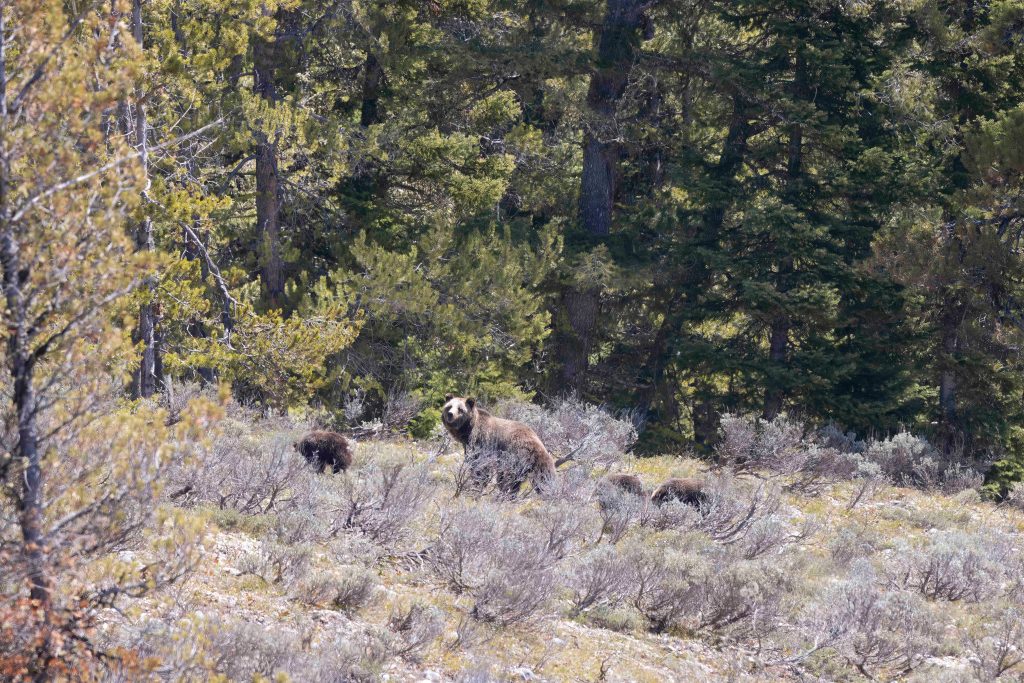
Previously, we coordinated on the radio that this was going to happen. We made sure folks were at a safe distance. Traffic was held so no one was driving by at the time. We had extra Law Enforcement officers on hand to help with the crowds and make sure everyone stayed safe. And we briefed as many people as possible about what they were about to see and why we were taking these measures. It sure wasn’t going to help them get a good photo at the moment, but hopefully it would ensure she was around for photos in the future. Visitors filmed me explaining all this to the crowd.
With my cluster of visitors at the North end of the safety zone, I answered more questions. Most people nodded their heads, seeing what we were trying to accomplish, but I could see that two visitors were driven by their emotions, so I gently disengaged, replying less and just letting them talk. Then another visitor chimed in, defending the park’s policy. I literally backed out of the circle to let them have their conversation.
That is when I noticed my boss walking towards us, across the empty safety zone. I went to brief him on what reactions were like (largely positive). And his reply stunned me, although I don’t know why. I should have expected it. He said, “I saw you were talking a lot with visitors, and I wanted to see if you needed help, or if anyone wanted to talk to me.” In all my years of employment, and I have had a few good bosses, I have never seen this level of leadership. I can’t begin to tell you how comforted I was, even though there was nothing he could do for me at that moment. And a visitor did come and share her thoughts with my boss. I later asked him if there was some part of their conversation that particularly seemed to help, so I might keep it in mind for future interactions with the public. He said surprisingly, she thought we should have an even larger minimum distance from animals in the park! Surprised again!
1063 and her family were seen later that afternoon by maintenance workers who have facilities down the Dump Road, but remained hidden from the public. As hoped, they were foraging on dandelions, roots, tubers, squirrel caches, and other tender shoots emerging as the snow continues to recede from the valley floor.
Unfortunately, the next time 1063 was spotted, she was in the developed area that evening, without her cubs.
We suspect infanticide — a male bear killing the cubs in order to bring the mother bear into estrus and mate with her. We aren’t sure, and as we start the next days shift we are especially focused on understanding what the true situation is. As luck would have it, the other person on duty is my boss’s boss (who stood up the first Wildlife Brigade). She ventured into the area where the family was last seen, and sadly discovered the bodies of two of the cubs. They had clearly been eaten after a big struggle. The third cub remains unaccounted for. There are no reports of a male sighted in the area, but that doesn’t mean they are not there — it is a closed area.
https://www.nps.gov/grte/learn/news/two-yearling-grizzly-bears-found-dead-south-of-colter-bay.htm
The mortality rate for grizzly cubs-of-the-year (COY) is 50%. For yearlings, which is what these cubs were, is 40%. I myself know of two cases of cubs being lost to a male grizzly (1 confirmed with collar data) happening in the park. It is sad, but not as rare as the public chooses to think.
We struggled to understand 1063’s choices. She had a collar last year, so researchers know a lot about where she got food and raised the cubs in 2024. There is a large peninsula adjacent to the Colter Bay developed area, a favorite area for hikers that she lived in for seveal months. Why did she not go there? She spent several months in back country (the rangers said it was an impressive distance!) raising the cubs. Why not head back? But this is people-think.
She was a new mom, she has to navigate food sources, other bears feeding in or passing through the area, and navigate people and their activities. She is a small grizzly and that likely led to her being pushed around in general. She is after all the bear we spent a good part of the spring and fall with, in view at Dump Road in 2023. Having cubs makes her more vulnerable to pressure from other bears. In bear hierarchy, males get the best food, single females next, and females with cubs get pushed to the margins. The margins being the places other bears don’t want to go, like near people and roadways.
The bear population, through careful management of the protected species is growing. Our boss cautions that with a healthy population it makes sense that more bears will bump into each other in competition for food sources or mating situations.
Nature can be pretty rough on individuals.
Now it is another shift day — back to work! This Wednesday morning there is a Brigade team on duty with me. We are called to a jam down on Willow Flats. I’d just been there! admiring the herd of elk in a picture perfect display in the early morning light with the red-orange willows and cloud-capped mountains as their backdrop. This bear was on a mission and walked at a fast pace from one side of the flats to the other, just below the dam. The jam never had time to get past 40 cars or so. Which was nice — that wind was biting cold, even with long johns and two coats on!
Later I discovered a fox hunting along Willow Flats. I had to ask people move a bit – they were 4 yards away from it when 25 is the required minimum distance. The grass has barely begun to green up here and mostly lays in large winter-wet clumps, making it easy to see the fox and when he claimed the reward for his hard work.
The next call we got was from the rangers at the Colter Bay Visitor Center. 1063 was at swim beach, the lake access next to the big RV campground. She is walking the shore line, where visitors are naturally taking pictures of the gorgeous bay and mountains. The LE was instrumental in getting her moved into the back country, the peninsula Dave and I have hiked a few times. She lived back there with the cubs for months last year. Would she stay?
Towards the end of my shift I was asked to help in a search. A report of unusually increased eagle and raven activity was noticed above the hillside at the far end of the maintenance yard. Cub size paw prints and poop piles had been found here yesterday. Suspecting this might be the location of the third cub, I joined two rangers to see if we could find the source of the bird activity, although we didn’t see any aerial maneuvers at the moment.
We found it.
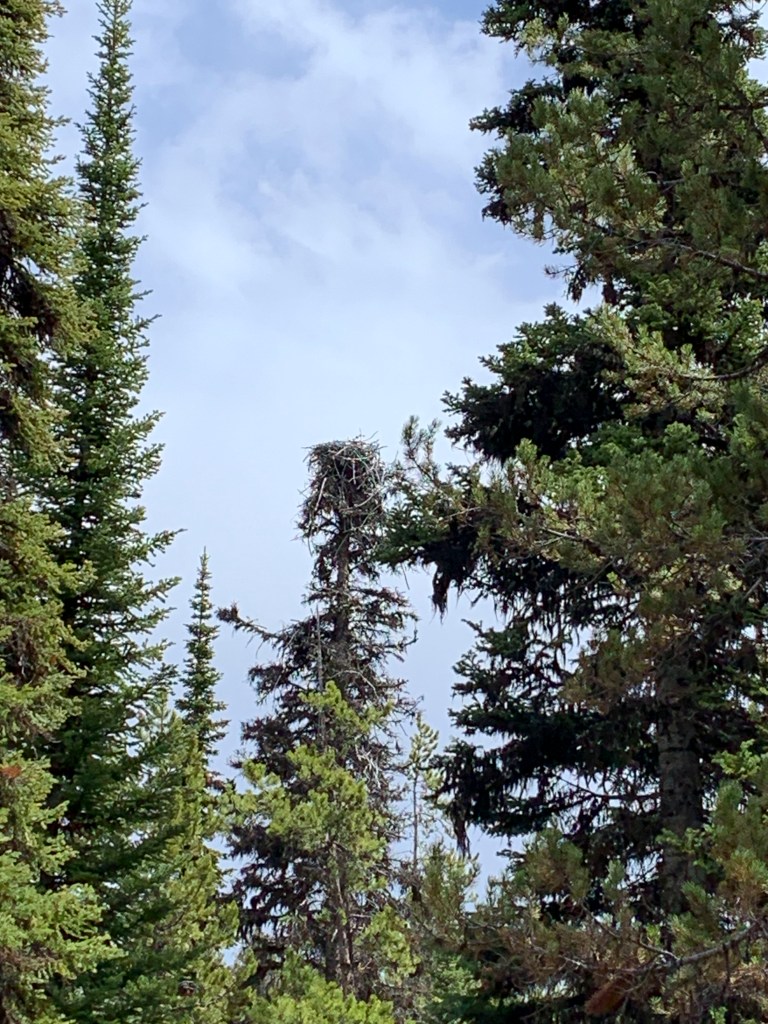
A bald eagle’s nest! When we had gotten half way up the hill we could hear the eagles screeching. Complaining about us, I imagine. We scanned the slope to see if they were feeding on something. The forest had been managed before, evidenced by the random black lumps left from previous controlled burn piles, which by the way look a lot like a small carcass. But as I looked up to determine if I could see the birds in the air, I spotted the eagle’s nest, resting atop a snag. With no new prints in the remaining snow drifts or other evidence of the cub or carcass, we decided the nest activity was the most likely reason for seeing the eagles more often.
So, I made it through my first four days on duty as a solo unit. The jams this week were incredibly dynamic, moving people, bears, and cones up and down the roadway without stop. Most lasting for me from 4 to 6 hours before getting turned over to the afternoon shift. On one day alone, 1063+3 required 42 man hours to maintain a handle on the situation.
Now I am off for three days. What shall I do? Unfortunately, the forecast is for miserably cold temps and lots of precipitation of the rain, snow, and graupel kind. And I still need to help with ad campaigns for RV WX, so this may be the perfect time for working on that. I’m going to revel in not speaking to a soul for a few days!
BEAR CUB UPDATE: A small miracle occurred! At 2:28 pm today our boss let us know that 1063 has reunited with the missing cub, near Colter Bay. “What a story he has to tell!”

